How Bees Use Propolis to Protect Their Hive
November 1, 2026 · The3Beez
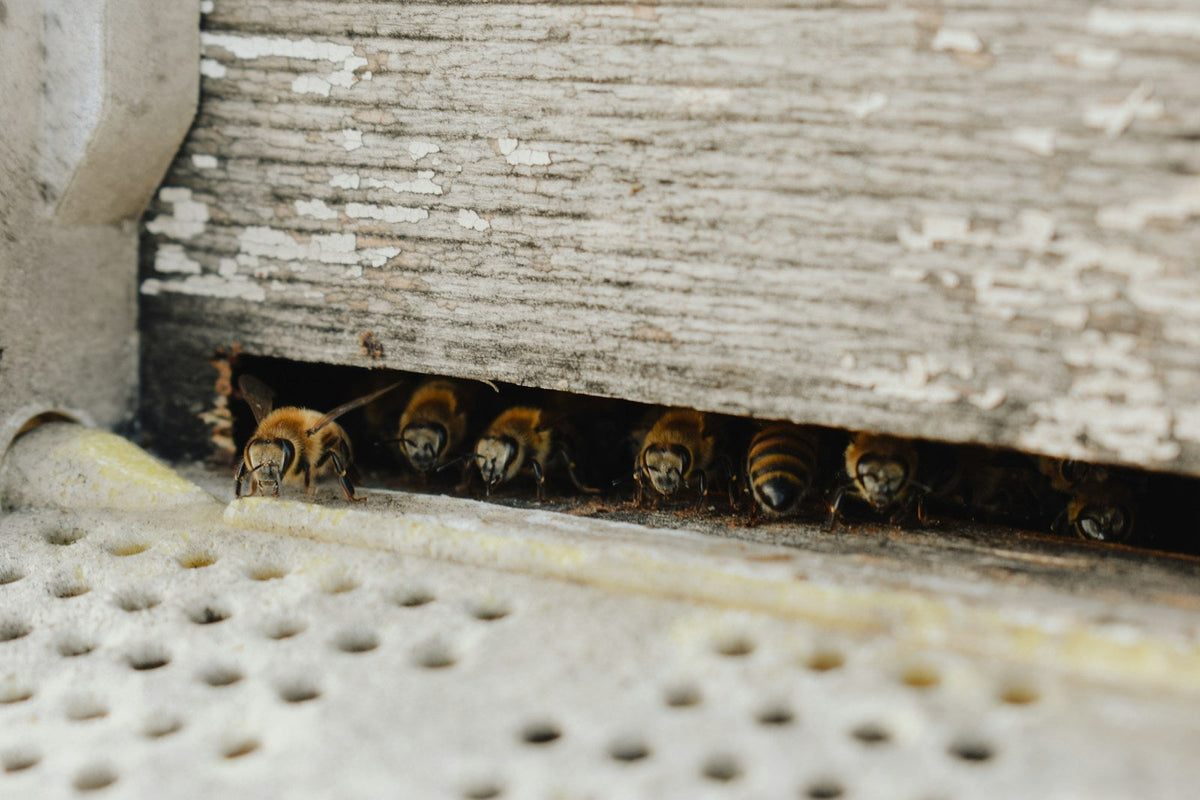
A hive is a closed home for tens of thousands of bees, their honey and their brood. To keep it sealed, bees use a substance they make from tree resin called propolis, or bee glue. If you have not read about the substance itself yet, start with What is propolis (bee glue)?
A small, specialised team
Not every forager collects resin. Only a small group specialises in it, prising it from tree buds and bark and carrying it on their hind legs. Curiously, such a bee cannot unload her sticky cargo by herself: she waits inside the hive until other bees come and pull the resin off her legs and put it where it is needed.
Sealing the cracks
The first use of propolis is closing gaps. The rule beekeepers know: a very small gap gets filled with propolis, a larger one gets built up with wax. That is why propolis sits on the edges of the frames and between the lid and the box, and why opening a hive takes a special tool.
Narrowing the entrance
In cold countries bees narrow the hive entrance with propolis before winter, making it easier to guard and less draughty. Resin collection usually rises in late summer and autumn.
Entombing intruders
If an animal too big to drag out gets into the hive, such as a mouse or a lizard, the bees sting it to death and then coat it in a layer of propolis. The body stays inside, sealed, so it does not rot or foul the home. Beekeepers really have found mice entombed this way inside their hives.

A full lining in wild nests
Wild colonies living in tree hollows do not just seal cracks: they coat the whole inside of the cavity with a thin layer of propolis. Researchers at the University of Minnesota studied this "envelope" and found that colonies living inside one do better, and that each bee spends less effort defending her own body, because the home itself has become a shield for everyone.
Modern hive boxes have smooth walls, so bees put less propolis in them. Some researchers have roughened the inner walls to encourage the bees to line them.
Not every bee uses it
The western honey bee is the heavy user of propolis, and some strains, such as Caucasian bees, are known for collecting a lot of it. The Asian honey bee does not collect resin at all and protects its home in other ways. For the roles bees play inside the colony, read Queen, worker and drone.
What it means for us
Every hive product tells part of the bee's life: honey from nectar, bee pollen and bee bread as the colony's food, beeswax as the walls, and propolis as the fence and the door. In our shop you will find bee pollen, bee bread and Kuwaiti Sider honey from our own apiaries.
Sources
- Simone-Finstrom & Spivak (2010), Apidologie: resin use by honey bees
- Borba et al. (2015), Journal of Experimental Biology: a natural propolis envelope and colony health
- Seeley & Morse (1976), Insectes Sociaux: the nest of the honey bee
- FAO: Value-added products from beekeeping (Krell, 1996), chapter 5: Propolis