The ingredients and herbs guide
What is running inside V12?
Ten ingredients and herbs in the jar, each with a story, traditions and studies — and one outside companion: bee pollen, sold separately or with the Future Generations Box. This guide presents them as they are, phrased to the measure of the evidence. This is food, not medicine.

Sider honey
Sider Honey
The foundation — the blend's baseThe story
Before any herb is mentioned, there is the honey itself. Sider honey is born from the nectar of the sider tree — the tree Arab tradition has honoured for centuries — and it is among the world's most precious honeys, deepest in colour and flavour. In V12 it is not a sweetener; it is the base on which every ingredient is built, and the carrier that brings them to your body.
The benefits in detail
Dark honeys like Sider are richer in phenolic compounds and antioxidants than light honeys — a general trend comparative honey studies point to: the darker the honey, the higher its content usually is. Its readily available natural sugars give clean energy with no additives, and its thick texture makes it an ideal carrier that preserves the herbs and delivers them. And in V12 specifically: the honey's identity is declared — Sider, named — not an anonymous 'honey blend', and it is cold-packed with no heating to touch its properties.
Common uses
- A spoon on an empty stomach in the morning — the oldest Arab energy ritual
- Sweetening warm drinks (without boiling, which spoils its properties)
- A traditional base for herb blends and tonics
- With nuts as an endurance meal before exertion

Ginseng
Panax ginseng
The wakefulness herb — studies indicateThe story
Some two thousand years in Chinese and Korean medicine, and it is still called 'the king of adaptogenic herbs'. Its Chinese name means 'man-root', because its roots take a human shape, and old wild roots were once weighed against gold. The ingredient that wakes the morning.
The benefits in detail
Among the blend's best-documented herbs for energy: multiple scientific reviews and meta-analyses point to support for reduced feelings of fatigue, higher mental and physical energy, and support for alertness and focus in long tasks. Moderate dietary doses are well tolerated by healthy people.
A note of honesty: anyone taking blood thinners or diabetes medication should consult their doctor — as written on all our pages.
Common uses
- Ginseng tea — East Asia's most famous functional drink
- With honey, in the Korean tradition specifically
- Korean samgyetang soup (chicken with ginseng)
- A common daily supplement for East Asian students and athletes

Royal jelly
Royal Jelly
The royal injector — early studiesThe story
A glandular secretion young worker bees make to feed the queen alone. On this food alone the queen grows to twice a worker's size, lives many times her lifespan, and lays hundreds of eggs a day. Nature offers no clearer metaphor for premium fuel.
The benefits in detail
A nutritional density rarely matched in a single substance: proteins and amino acids, unique fatty acids — above all 10-HDA, found nowhere else in nature — and the B-vitamin group. Small human studies point to support for markers of vitality and general activity, and its tradition as an energizer has been established in Japan and Europe for decades.
The standing warning: anyone allergic to bee products should avoid it.
Common uses
- Taken in the morning mixed with honey — as in V12
- Among Japan's most popular daily supplements
- Found in the finest beekeepers' blends worldwide

Tongkat ali (Ali's staff)
Eurycoma longifolia — Tongkat Ali
The resolve herb — studies indicateThe story
A long root dug from deep in the rainforests of Malaysia and Indonesia. The tale goes that an old man named Ali leaned on a staff cut from its root, and the root took his name. In Southeast Asian tradition it is, without rival, the first herb of men.
The benefits in detail
Among the strongest-documented herbs in its field: a recent systematic review and meta-analysis (2022) point to support for vitality levels in men, clinical trials point to reduced fatigue and improved stress and mood markers, and a study in older adults indicated improved strength markers. The quiet strength that shows at the end of the day, not its start.
Common uses
- The boiled-root drink — the original Malaysian way
- The popular 'tongkat coffee' of Malaysia and Indonesia
- A fixture of Asian endurance blends

Ashwagandha
Withania somnifera — Ashwagandha
The athlete's herb — the strongest evidence in the blendThe story
The crown of India's Ayurvedic herbs for some three thousand years. Its Sanskrit name hints at 'the strength of the horse' — and that is how the ancients described it: a herb that grants a horse's stamina. Today it is the most studied adaptogenic herb in the world.
The benefits in detail
The best-documented ingredient in V12 outright: systematic reviews and meta-analyses point to support for strength, endurance and peak-fitness markers (VO2max), lower stress and cortisol markers, and improved sleep quality — and deeper sleep is itself the fuel of recovery and performance. The athlete's herb of the blend.
Note: thyroid patients should consult a doctor.
Common uses
- With warm milk at night — the classic Indian way
- A popular recovery supplement among athletes
- Ayurveda's calming evening blends

Maca
Lepidium meyenii — Maca
The highland root — early studiesThe story
A root grown above four thousand metres in Peru's Andes — where the air is thin and frost kills other crops. It was the food of Inca warriors, and highland people still eat it daily. A plant that learned to live where nothing lives.
The benefits in detail
Small human trials point to support for mood, energy and general activity, and it is a well-tolerated whole food the Andean peoples eat by the kilogram. Its reputation for endurance at altitude — where oxygen is scarce — is the heart of its story: the root of the long breath.
Common uses
- Powder in juices and sports smoothies
- With oats or coffee in the morning
- A traditional daily food in Peru

Epimedium
Epimedium
The storied herb — known traditionallyThe story
Centuries ago a Chinese shepherd noticed a change in his flock's vigour after it grazed on one particular mountain herb — so the herb entered the Chinese herbals bearing his story, and stayed there a thousand years. One of the most famous herbs of Chinese tradition in the field of vitality and activity.
The benefits in detail
Known traditionally among the vitality and activity herbs of old Chinese medicine, and its best-known compound, icariin, has been studied in the laboratory. Human studies remain limited — so we keep our wording within the bounds of tradition, and that is our commitment to honesty across this whole guide: every herb is described to the measure of its evidence.
Common uses
- Traditional Chinese herbal tea
- Old vitality infusions and blends
- A regular fixture in East Asian blends

Damiana
Turnera diffusa — Damiana
The mood herb — known traditionallyThe story
An aromatic shrub from Mexico and Central America, known to the indigenous peoples centuries ago and folded into their relaxation and mood drinks. Rub its leaves and they release a warm aromatic scent — the evening note of the blend.
The benefits in detail
Known traditionally for easing stress and supporting mood and evening relaxation. Modern human studies are limited, so it is described here as it is: a venerable tradition in its homeland, not a scientific promise. A calmer evening means a more active tomorrow — and that is its role in the formula.
Common uses
- An evening herbal tea in Mexico
- Traditional relaxation blends
- Warm herbal drinks before sleep

Tribulus (caltrop)
Tribulus terrestris
The heritage plant — known traditionallyThe story
A thorny plant that crept across civilizations: from the Mediterranean basin to Indian Ayurveda to the books of China. You will rarely find an herbal tradition that does not mention it under activity — a shared inheritance of nations that share nothing else.
The benefits in detail
Its standing in activity blends is broad and traditional, across several cultures. And in complete honesty: recent scientific reviews do not support a strong documented effect for it — we list it here as a respected shared heritage, not a promise. That very honesty is what sets this guide apart: had we wanted to exaggerate, we would have exaggerated everything.
Common uses
- Heritage blends of the Mediterranean, India and China
- Traditional herbal tea
- Folk-heritage supplements

White musli
Chlorophytum borivilianum — Safed Musli
The classic partner — traditional, with early studiesThe story
One of Ayurveda's most prized and expensive roots; its white fingers have been dried and ground in India for centuries. Ayurveda classes it among the classic vitality herbs, and it is ashwagandha's historic partner — where one is found in an old blend, the other is usually found too.
The benefits in detail
Its richness in saponins is the secret of its standing — they are its studied active compounds. Early and animal studies point to support for activity and endurance, and its Ayurvedic rank in the field of men's vitality is among the highest of the roots. In V12 it works where ashwagandha works, as the two have always worked together in tradition.
Common uses
- With warm milk in the Indian tradition
- Powdered in fortifying Ayurvedic blends
- Used in traditional Indian endurance sweets

Bee pollen
Bee Pollen
The protocol's companion — sold separately or with the Future Generations BoxThe story
Golden granules the bees gather from flowers and knead into food for the hive — beekeepers call it 'bee bread'. In the official V12 protocol it holds a special place: two grams with every dose, weighed on the scale that comes in the box.
The benefits in detail
Nutritional density in tiny granules: proteins, amino acids, vitamins and minerals. Early nutrition studies support its value as a concentrated food, and beekeepers' tradition has offered it for centuries to those who want sustained energy, not a passing surge.
The same warning: a bee-product allergy means avoid it.
Common uses
- Sprinkled over yoghurt and smoothies
- A small spoon in the morning with honey
- The two grams accompanying every V12 dose
The products of this guide
V12 Honey — the Men's Blend

Ten ingredients and herbs on a base of Sider honey — and a 14-day return guarantee.

The protocol's companion — sold separately, and the two grams accompanying every dose come with the box.

The foundation and the royal injector together — for anyone who wants the pair before the full blend.
From The3Beez
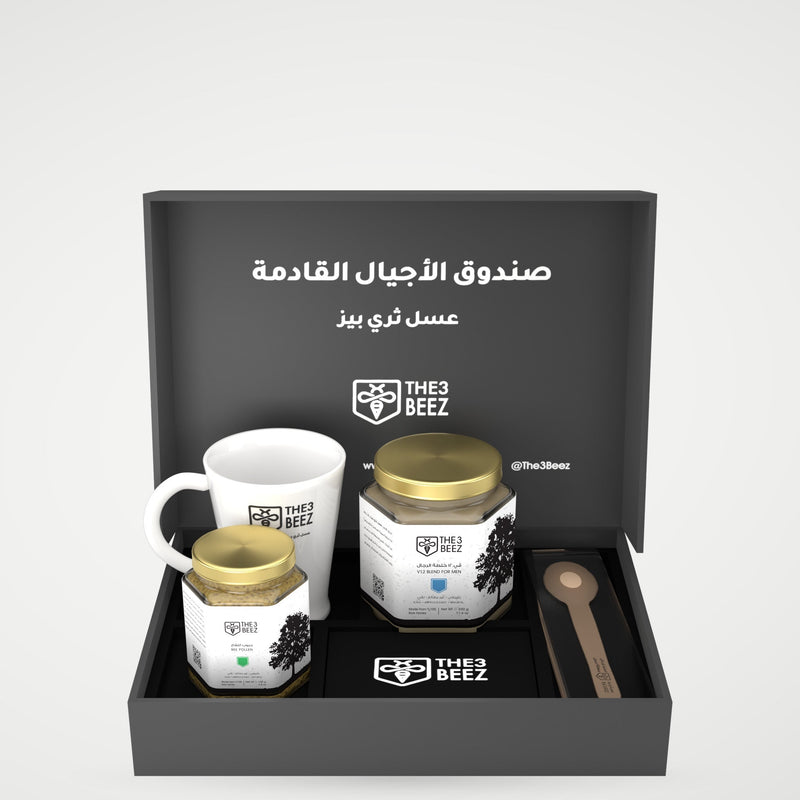
The Future Generations Box
Dear sir, The3Beez brings you a blend made specifically for you — and for it to have its effect, it must be taken consistently. That is why the box comes with everything that keeps the dose measured.
How to use it — from the booklet itself
Stay with me — no getting lost, no guessing; everything is measured, right down to the scale:
- Place the The3Beez cup on the electronic scale and switch it on
- Press the (TARE) button to zero the scale
- Stir the honey so it blends evenly, and put 25 grams of the blend into the cup
- Press the (TARE) button again and add 2 grams of bee pollen
- Pour your favourite drink over them — it's best with warm milk (optional)
- Repeat this once in the morning and once in the evening
- The pack lasts 10 days if you keep to the suggested doses consistently
- These amounts are suggestions — you can increase or reduce the quantity as you wish
- We know you're in a hurry, but it all depends on your body and how it responds
References
The information in this guide rests on the following sources. The ingredients are described as their traditions and studies know them — not as a therapeutic promise.
- Systematic review and meta-analysis (2022) on Eurycoma longifolia (tongkat ali) extract, men's vitality and stress markers — the PubMed medical research databases.
- Systematic reviews and meta-analyses on ashwagandha (Withania somnifera): strength, endurance and the VO2max maximal-oxygen marker — peer-reviewed sports nutrition journals and PubMed databases.
- Meta-analyses of randomized trials on ashwagandha, stress reduction, cortisol markers and sleep quality — PubMed databases.
- Meta-analysis of clinical trials on Asian ginseng, fatigue and mental energy — Journal of Ginseng Research.
- Review of small human trials on maca (Lepidium meyenii), mood and energy — PubMed databases.
- The nutritional composition of royal jelly and its unique fatty acid 10-HDA — peer-reviewed food science journals.
- Bee pollen: nutritional composition and value as a concentrated food — nutrition science reviews.
- White musli (Chlorophytum borivilianum) in Ayurvedic sources and early studies — reviews of traditional Indian medicine.
- Systematic review of the recent evidence on tribulus — PubMed databases (its conclusion is that the evidence is weak, and we have reported it as it is).
- The link between dark honey colour and phenolic/antioxidant content — honey research and comparative nutrition journals.
- US Food and Drug Administration (FDA) warnings about 'men's honey' products containing hidden, undeclared drugs — the agency's public data, 2022–2023.
- Epimedium and damiana in traditional Chinese and Mexican herbals — traditional herbal references.